Normal-Bad Sex
The brief
Normal-bad sex is the category most of us have a story in and no vocabulary for. It’s the stories that are negative but not traumatic, the night that stays with you for a long time because you can’t quite name what went wrong.
Normal-Bad Sex is a collection of playable podcasts that gives that category a place to land. Each episode pairs a real interview, recorded with someone who has already sat with what happened, alongside a small set of mini-games that don’t dramatise what’s being said. The mechanics highlight the speaker’s emotion.
It was conceived and co-designed with Nyusha Iampolski and Sophie Chu at NYU Game Center, and funded by an NYU grant.
Talking about this doesn’t need to be life or death.Design principle we kept coming back to
The work
Between mini-games, the player sits at a bar with the speaker, or a jungle stand-in for the speaker, and listens. To keep the hands busy without pulling focus, I added a popcorn fidget to play with. It acts as a short pause between each minigame.
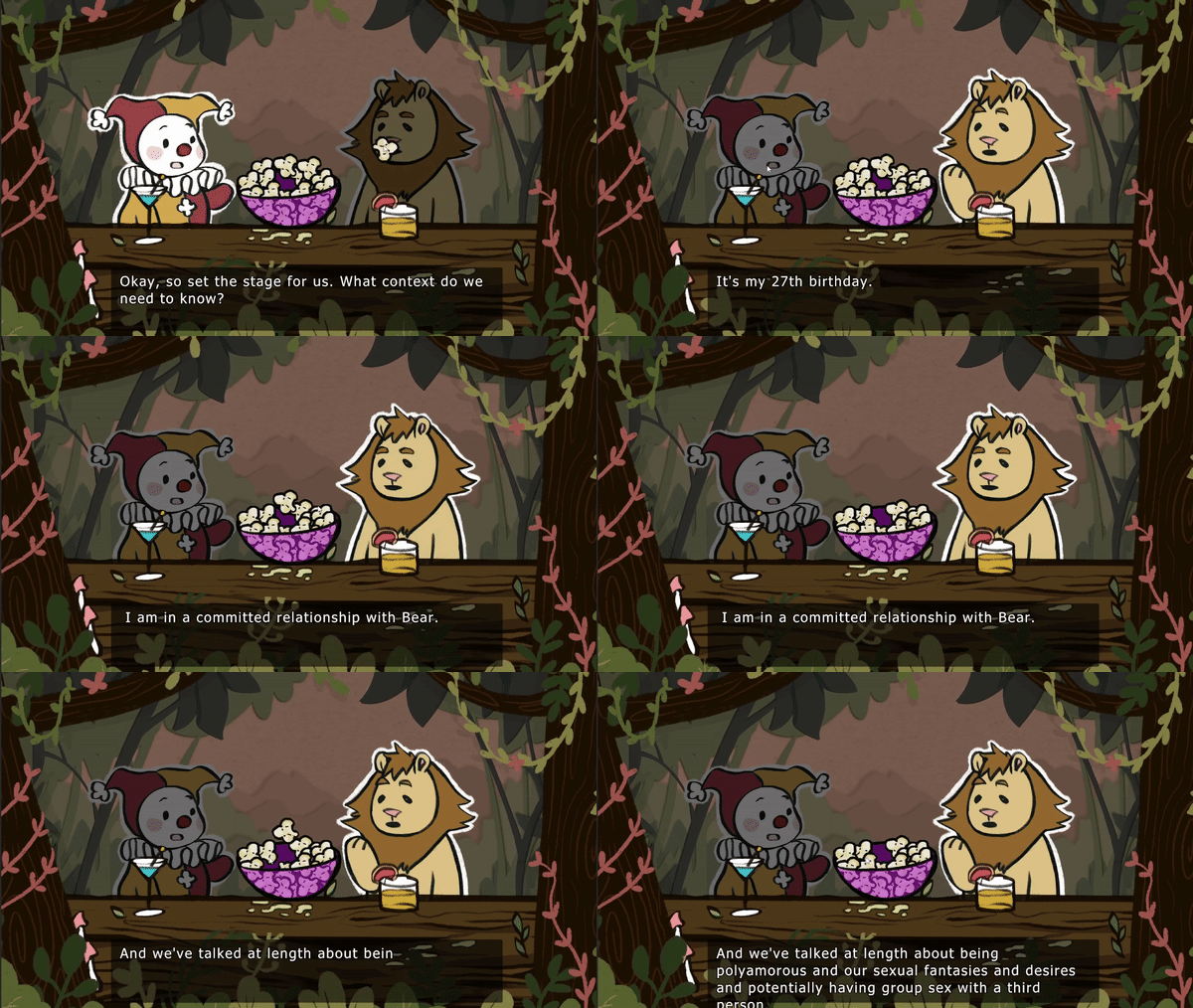
The mini-games are metaphorical. Each one is a small interaction that mirrors how the speaker felt at a given moment. A birthday box you unwrap, over and over, until the label finally reads something you didn’t ask for.
.gif)
.gif)
.gif)
.gif)
.gif)
.gif)
Every episode starts as an interview. Nyusha records it and cleans the audio; we transcribe it together and edit the text down to the shape we want to tell. Then a second pass: we edit the audio to match the trimmed text, and start pulling verbs out of the transcript, moments where the speaker’s feeling should be emphasised.
Episode two is about aging. The interview is with a woman in her seventies recounting her sexual life across the decades, and the game is structured around that, each decade is laid out as a different road in New York City. To populate the streets, I built a procedural building generator: a system of variables that produces normal buildings across a stretch of road, with custom buildings dropped in at the key story beats.
The procedural buildings are the background. The custom ones are the story. Passing through the road auto triggers some parts of the story with characters and custom buildings triggering the other related stories.
How it landed
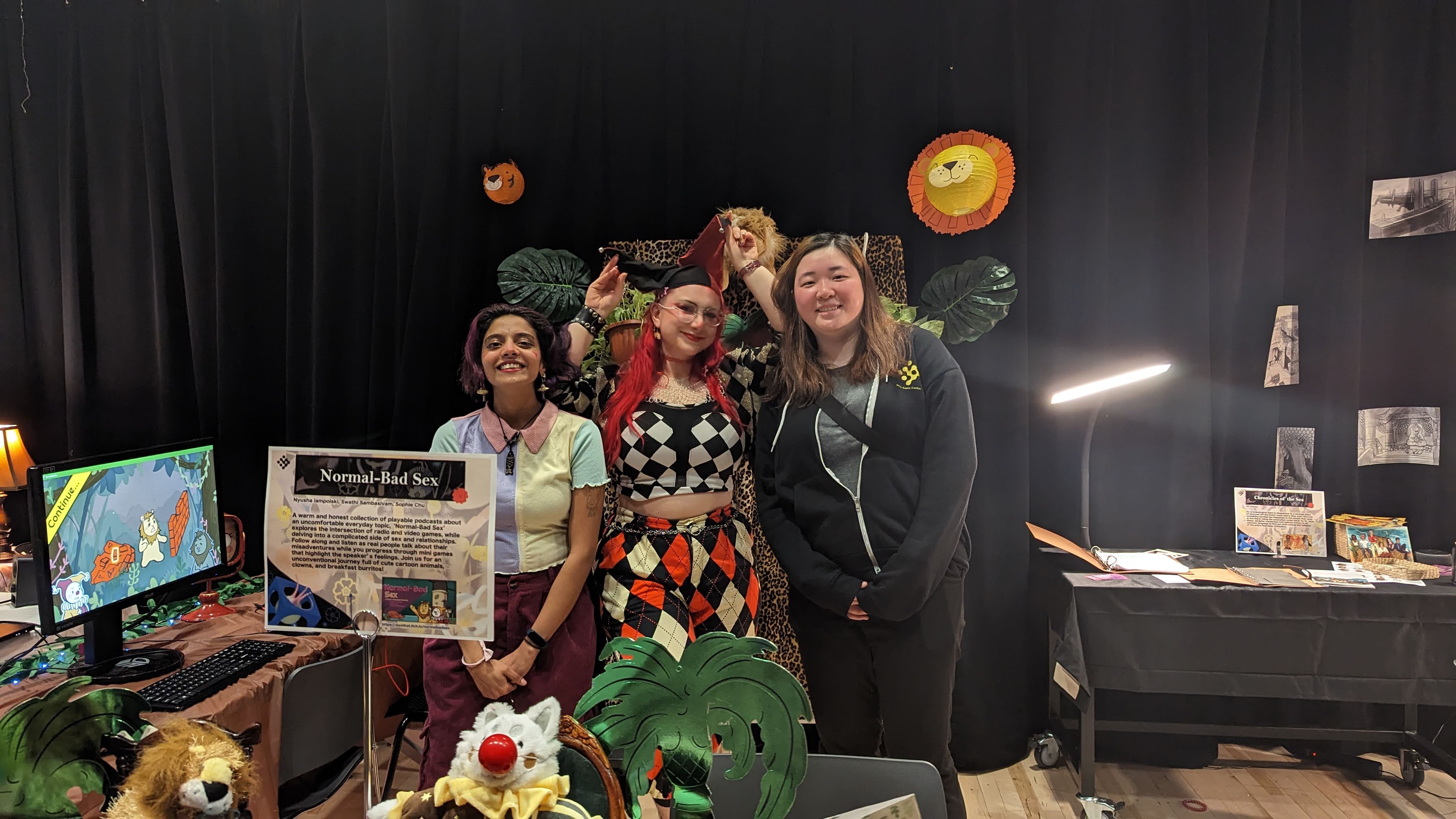
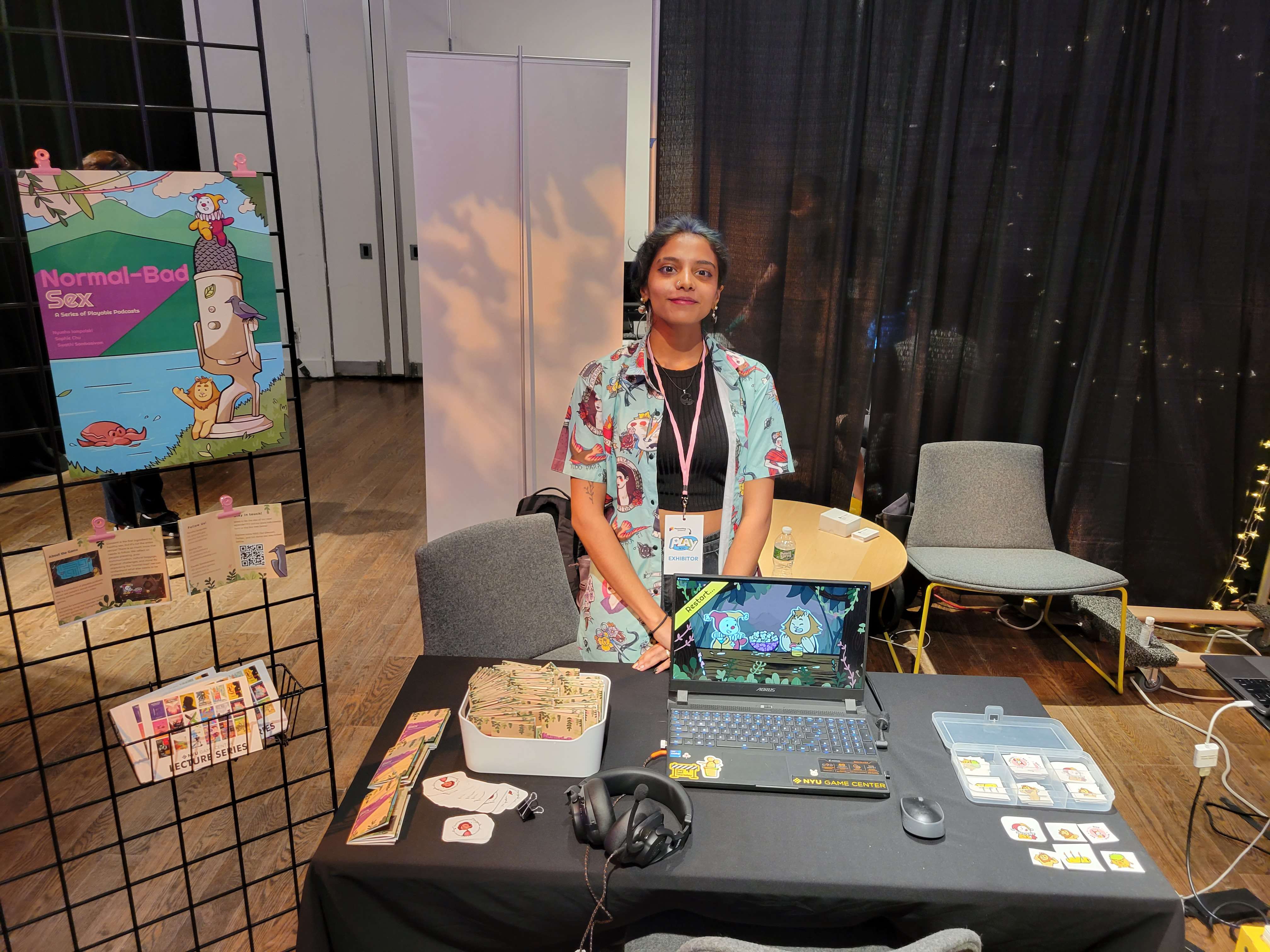
Funded by an NYU grant. Episode one shipped as the proof of concept and was shown at GDC 2023 and Play NYC 2023; episode two is in development.
Credits
Team
Nyusha Iampolski · concept, engine / code, interview, audio
Swathi Sambasivam · UI, mini-game art, audio
Sophie Chu · character portraits, mini-game art, promo materials (Episode 1)
Eugene An · supporting location art (Episode 2)
Tools
Unity · C#
Fungus
After Effects
Procreate · Audio editing
Thanks to Naomi Clark, Lawra Clark, Mattie Brice, Danny Hawk, Clara Fernandez-Vara, Shawn Pierre, Chros Wang, Eva Maldonado, Lee McGirr, Jude Pinto, every playtester, the MFA classes of 2022, 2023, and 2024, the Fungus Discord, and our therapists.